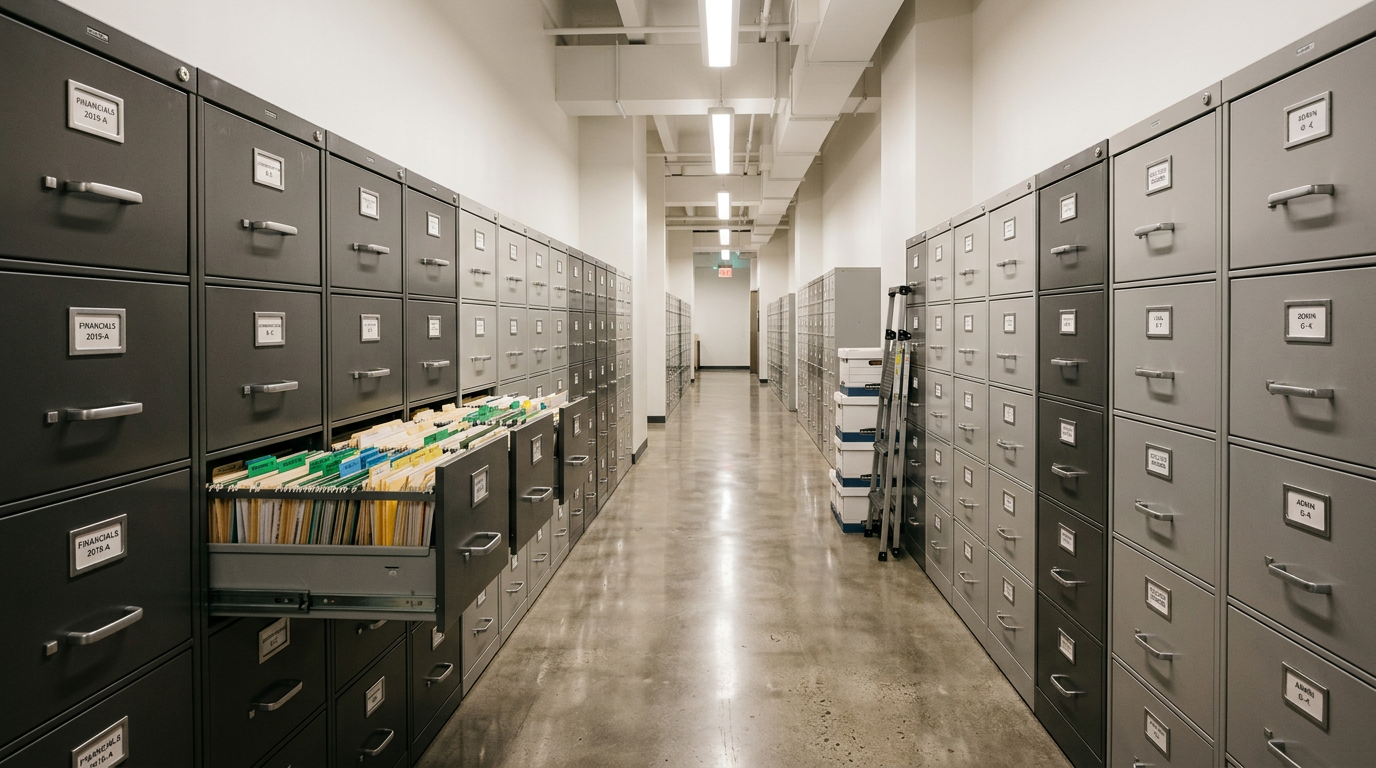
Archive rooms are critical storage areas where official documents, legal papers, land records, court files, medical records, financial documents, and historical materials are kept for long periods. The physical integrity of the documents protected in these areas is directly dependent on environmental factors such as temperature, humidity, air quality, and light exposure. Uncontrolled conditions can lead to irreversible damage in a short time.
Especially in structures with legal storage obligations such as public institutions, judicial archives, university libraries, banks, insurance companies, and healthcare organizations, monitoring archive conditions carries importance not only for document preservation but also for legal compliance, audit readiness, and corporate responsibility.
The ISO 11799 (Document Storage Requirements) standard envisages that temperature and humidity values in areas where archive and library materials are kept should be kept under continuous control, environmental conditions should be recorded, and they should be periodically auditable. TSE 3572 and ICPAL (International Conservation and Archive Laboratories) guidelines similarly define separate environmental condition requirements for paper, film, magnetic media, and digital storage media. Therefore, in archive rooms, not only instantaneous measurement is sufficient; continuous data recording, deviation warnings, and retrospective reporting infrastructure are expected.
Continuous monitoring of temperature and humidity conditions in archive rooms is indispensable for preserving document integrity, meeting legal storage obligations, and ensuring audit requirements.
In many institutions, archive rooms are still monitored through periodic manual checks. However, measurements taken a few times a day only reflect the status at that moment. Especially during weekends, public holidays, and non-working hours, climate control failures, humidity rises, or power outages often progress unnoticed and can cause damage that is difficult to reverse. Today, institutions now prefer to track archive conditions instantaneously through centralized monitoring systems instead of these methods.
Moreover, not every archive room requires the same sensitivity. Both temperature and humidity thresholds, as well as ventilation requirements, differ between an area where paper documents are stored and a section where microfilms, magnetic tapes, or digital backup media are located. In special archives where historical documents or rare works are protected, additional UV protection and access controls also come into play. Therefore, it is of great importance not only to measure temperature and humidity but also to know when the deviation started, how long it lasted, and who was notified when.
Key Risks Encountered in Archive Rooms
Humidity Changes and Molding
Uncontrolled humidity levels lead to molding, sticking, and irreversible deterioration in paper, leather, and textile-based materials. Especially in archives located in basements or ground levels, the humidity ratio can change rapidly seasonally. Therefore, continuous monitoring of humidity values and giving instant warnings in case of threshold exceedance is of critical importance.
Temperature Fluctuations
The ideal temperature range for archive materials is generally accepted as 18-22°C. Sudden temperature increases can cause paper to dry and become brittle, while decreases can cause condensation and humidity accumulation. Fluctuations resulting from climate control failures or seasonal changes may go unnoticed without continuous monitoring.
Power and Climate Control Outages
Power outages cause climate control and dehumidification devices to go offline. Especially outages occurring during non-working hours can last for hours unnoticed, and ambient conditions can deteriorate rapidly. Instant monitoring of power status and sending automatic notifications to authorities minimizes this risk.
Fire and Smoke Risks
Paper-intensive environments carry a high risk in terms of fire. Fire hazards arising from electrical contact, overheating, or external factors can be detected early with monitoring systems. Sudden rises in temperature sensors can be evaluated as a pre-fire warning signal.
Flooding and Leakage
Plumbing failures, rainwater leaks, or underground flooding can cause irreversible damage to archive materials. Especially archive areas in basements and ground floors are extremely vulnerable to this risk. With water detection sensors, leaks or accumulations are detected instantly and automatic notifications can be sent to relevant teams; thus, document loss can be prevented by minimizing intervention time.
Unauthorized Access and Door Control
Unauthorized access to archive rooms directly threatens document security. Leaving doors open poses a risk in terms of both security and ambient conditions. Door durations can be tracked with door sensors, and automatic notifications can be sent to relevant personnel when the determined duration is exceeded.
What Does Birtech Provide in This Area?
End-to-end solution from hardware to software, from alarm management to after-sales support:
Field-Proven Hardware
BirSens sensors and control modules developed for critical environments stand out with features such as easy installation, low failure rate, and high reliability. Thanks to software and hardware integrity, the system operates end-to-end with Birtech assurance.
Temperature and Humidity Tracking Simultaneously
Temperature, humidity, and door status in archive rooms are monitored simultaneously with Sensaway and Noctua. All data is recorded with date and time stamps; it can be queried at any time retrospectively.
To the Right Person, at the Right Moment
Notification flows via email, SMS, and calls are created for situations such as humidity threshold exceedance, temperature deviation, power loss, or open doors. Different alarm scenarios can be defined for each archive section.
Time-Based and Seasonal Alarm Rules
Custom rule definitions can be made for specific hours and days during planned operations such as maintenance or cleaning. A deviation that might remain at a warning level during working hours can be escalated to a critical alarm during night hours or weekends. Different humidity and temperature thresholds can be determined for summer and winter periods, ensuring alarm management compatible with seasonal conditions.
Smart Rules with Super Sensor
Logical alarm scenarios combining multiple conditions can be defined via Noctua software. For example: "If humidity exceeds 60% AND the climate control system is off, GIVE CRITICAL ALARM" — with such rules, unnecessary notifications are prevented, and only real risks generate alarms. Similarly, intervention times are shortened by establishing multi-condition scenarios like "If the air quality sensor detects an abnormality AND it is outside working hours, CALL the security team" or "If water leakage is detected AND the archive room door is locked, INFORM both security and facility management."
Water Leakage Detection
Plumbing failures, rainwater leaks, or underground flooding are detected instantly with water leakage sensors placed at the floor level of archive areas. As soon as the leak starts, automatic notifications are sent to relevant teams, minimizing intervention time and preventing document loss.
Air Quality and Early Fire Detection
Particulate, gas, and smoke changes in the environment are continuously monitored with air quality sensors. These sensors can detect abnormalities in air composition at a much earlier stage than traditional smoke detectors — before visible smoke occurs — and provide advance warning of a potential fire risk.
Door and Access Control
Door open durations are tracked with sensors, and automatic warnings are generated when the determined duration is exceeded. Entries and exits can be recorded with access control integration in high-security archive areas.
2D Visualization and Heat Map
Archive areas can be visualized in 2D with Noctua. Instead of complicated tables, in which region an alarm occurred is understood directly via the visual screen. Preventive intervention is enabled for the positioning of ventilation or dehumidification devices by identifying hot and humid spots through the heat map.
Control Is Yours Even When in the Field
With Android and iOS applications, you can receive instant notifications from anywhere, view the status of all archive areas, and quickly access basic reports.
Ready When the Audit Comes
Retrospective reports for ISO 11799 and corporate audit processes are automatically generated. Sensor reliability can be documented with TURKAK-accredited calibration certificates.
Support That Ensures Continuity
Maintenance, calibration and support services provided under SensCare® protect the operational continuity of systems. Continuous support is provided for critical infrastructures.
Reliability Is Proven in the Field
The indicator of the right solution in critical document storage areas and archive management is its continuous use in the field for years and maintaining the trust of users. Birtech actively serves in a wide range from public institutions to judicial archives, from university libraries to the financial sector.



Let Us Determine the Right Solution for You Together
Let us create a custom system architecture according to the number of archive areas, monitoring points, and audit needs. Submit your request, and our team will contact you within the same day in most cases, within 24 hours at the latest.