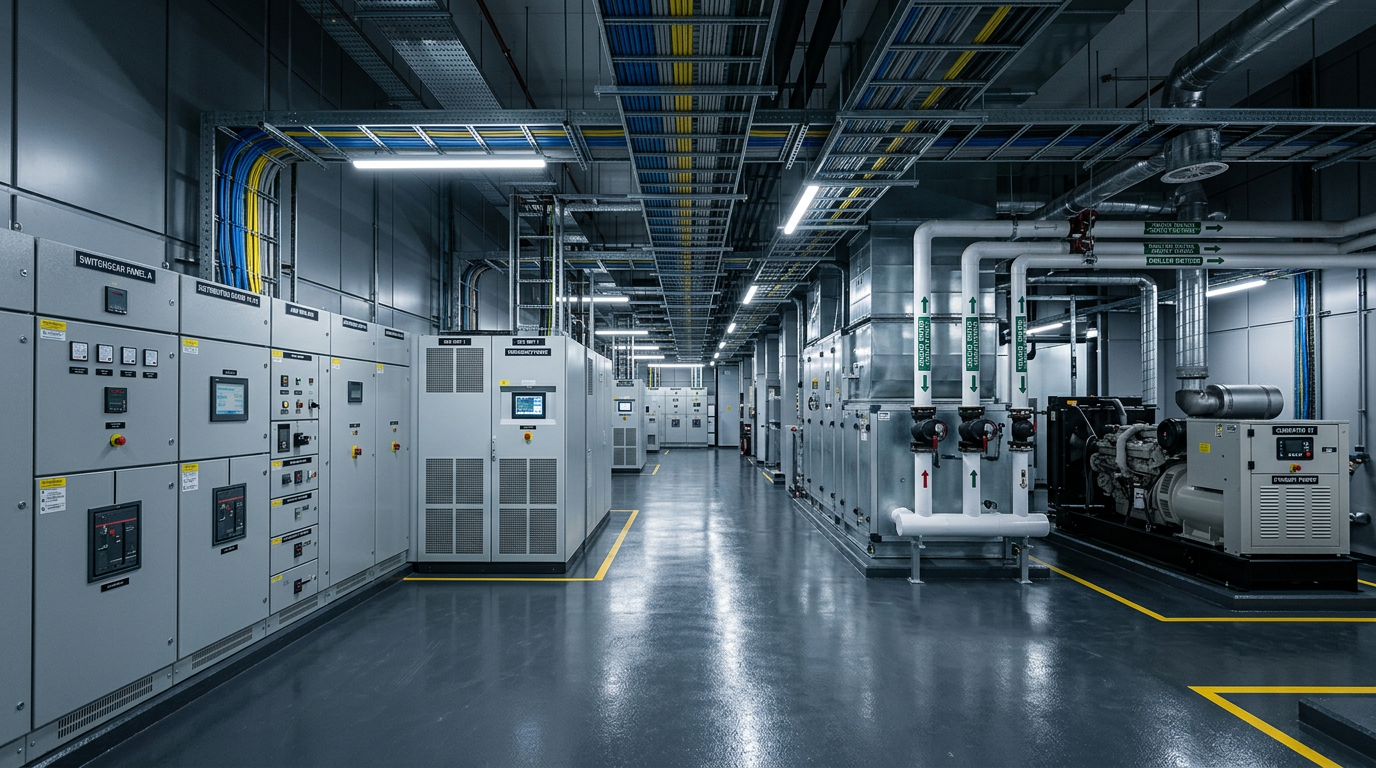
Technical service and energy rooms are the volumes that house critical infrastructure components forming the life source of the building, such as generators, UPS units, transformers, electrical panels, air handling units, and mechanical installation equipment. These areas are generally located in basements or rooftops, under limited ventilation and access conditions; however, the healthy operation of the equipment they contain directly affects the operational continuity of the entire building.
Uncontrolled environmental conditions in technical volumes lead to serious consequences: excessive heat in the generator room reduces engine performance and causes failures, inadequate cooling in the UPS room shortens battery life, and humidity accumulation in the transformer center can lead to loss of insulation and short circuits. Water leakage in electrical panel rooms poses a serious risk threatening life safety. Traditional periodic checks are insufficient to catch sudden changes in these volumes.
With Noctua software and BirSens hardware, all critical parameters in technical service and energy rooms are continuously monitored, instant notifications are sent when thresholds are exceeded, and historical data is reported. This enables facility managers to detect equipment failures in advance, conduct maintenance processes in a planned manner, and optimize energy costs.
Instant monitoring of temperature, humidity, water leakage, energy consumption, and access security in technical service and energy rooms is vital for extending equipment life, reducing failure risks, and ensuring operational continuity.
These areas represent the heart of the building's energy and mechanical infrastructure. Technical volumes with different functions, such as generator rooms, UPS rooms, transformer centers, main distribution panels, air handling unit rooms, boiler rooms, and pump stations, each harbor unique environmental conditions, risk profiles, and monitoring requirements. Therefore, holistic monitoring of all technical volumes through a centralized platform is a strategic necessity.
Key Risks Encountered in Technical Volumes
Overheating and Inadequate Ventilation
Generator rooms, UPS rooms, and transformer centers house equipment that generates intense heat. In the event of inadequate ventilation or air conditioning failure, the ambient temperature rises rapidly; this situation shortens the life of UPS batteries, weakens transformer insulation, and reduces the efficiency of the generator engine. Especially in summer months or in basements, temperature control is a critical necessity.
Water Leakage and Humidity Accumulation
Plumbing leaks, condensation accumulation, or groundwater seepage are common risks in technical volumes located in basements. Water leakage in electrical panel rooms or transformer centers poses a serious threat in terms of short circuits, equipment damage, and even life safety. Early detection of water leakage is of vital importance in these areas.
Power Outages and Generator Failures
Failure of the generator to activate on time during grid outages, insufficient fuel levels, or ATS (Automatic Transfer Switch) failures cause outages affecting the entire facility. Decreased UPS battery capacity leaves critical systems unprotected. Continuous monitoring of generator operating status, fuel level, and UPS battery health is mandatory.
Fire and Smoke Risks
Overloading in electrical panels, loose cable connections, transformer oil leaks, or short circuits due to dust accumulation increase fire risk. By continuously measuring particle density in the air and monitoring temperature rise trends with air quality sensors, fire risk can be detected at an early stage before damage occurs.
Unauthorized Access and Security Breaches
Technical volumes are critical areas providing direct access to the building's energy and mechanical infrastructure. Entry of unauthorized persons into these areas can cause sabotage, accidental intervention, or security breaches. Controlling door access management through a centralized system and monitoring access control devices and camera recordings in an integrated manner is necessary for security.
Energy Inefficiency and High Costs
Energy consumption in technical volumes usually constitutes a significant portion of the building's total energy expenditure. Over-operation of air conditioners, pumps, and fans, unbalanced load distribution, and equipment operating with low efficiency cause energy waste. Monitoring energy consumption on a location and equipment basis is of critical importance for cost optimization.
What Does Birtech Provide in This Area?
End-to-end solution from hardware to software, from critical infrastructure monitoring to energy management:
Field-Proven BirSens Hardware Family
With custom-designed control modules, temperature/humidity sensors, strip and point water leak sensors, door contact sensors, air quality sensors, access control solutions, and motion-sensitive camera solutions, the BirSens hardware family provides high precision, wide measurement range, and uninterrupted data transmission in the harsh conditions of technical volumes.
Vendor-Independent Critical Infrastructure Integration
Noctua software enables monitoring and management of data from generators, UPS, air handling units, energy analyzers, and other mechanical/electrical equipment through a single platform regardless of brand and model. Devices from different manufacturers are unified in a common infrastructure, providing a centralized and holistic control experience.
Dashboard Module
Provides an advanced visualization structure where users can fully customize their monitoring screens. Panels that can be easily designed with drag-and-drop can be created as templates suitable for different screen resolutions and VideoWall structures. Not only sensor data but also operational information such as event reports and access reports can be displayed on the dashboard. Furthermore, an interactive and dynamic monitoring experience is provided with live camera images, text, and visual fields.
Super Sensor
Enables users to create their own virtual sensors using existing sensor data. Through this structure, which can be designed completely with drag-and-drop logic without requiring coding knowledge, data coming from one or more sensors can be combined with mathematical or logical operations. For example: "If generator room temperature exceeds 45°C AND the ventilation fan is not running, CREATE CRITICAL ALARM and CALL the technical team" — such multi-condition scenarios can be defined within minutes.
Energy Cost Management
Provides the ability to monitor energy consumption, cost, and efficiency ratios in technical volumes from a single screen. Consumption is tracked through energy analyzers and current meters based on location, device, or category; energy costs can be reported in both kWh and local currency. Consumption and cost limits can be determined by creating daily, weekly, or monthly target cards; the system sends automatic notifications when the target is exceeded.
Instant Monitoring with Energy Single Line Diagram
Noctua visually presents the building's energy distribution infrastructure from the transformer inlet to the final distribution panels on a single line diagram. Voltage, current, power, and energy consumption values at each node can be monitored instantly through the diagram. In case of an outage or failure, the source and impact area of the problem are visually detected within seconds; thus, technical teams can provide rapid intervention to the right point. It supports both operational continuity and energy efficiency by keeping the entire energy distribution hierarchy under control from a single screen.
Physical Security Management Module
Combines access control, monitoring, and security event management in technical volumes into a single platform. With the Integrated Door Security feature, each door can be defined; door sensors, access control devices (card or biometric), and cameras can be added to these doors. When a door is opened, the system evaluates these components as a single event and produces a single notification; thus preventing notification pollution. With shift definitions, only authorized personnel can be allowed access during relevant time periods.
Notification Efficiency and Optimization
Noctua offers a focused and efficient system management experience by ensuring users receive only important and meaningful notifications. With decreasing notification frequency over time, delivery intervals automatically become less frequent as events age. With location event summaries, instead of separate emails for each event, all open events within a location-based single summary email are delivered at certain periods. With the door notification feature, door sensor, access control device, and camera movements are combined under a single event.
2D Visualization
Technical volume plans can be visualized in 2D with Noctua. The current status, temperature distribution, and alarm status of areas such as generator rooms, UPS rooms, transformer centers, and panel rooms can be monitored directly through the plan. Thus, which volume has a problem is instantly detected visually, and the intervention process accelerates.
24/7 Remote Access and Mobile Control
With Android and iOS applications, you can receive instant notifications from anywhere, view the status of all technical volumes, and quickly access basic reports. When a critical alarm arrives during night hours or weekends, you can evaluate the situation from your phone and coordinate the necessary intervention.
Support That Ensures Continuity
Maintenance, calibration and support services provided under SensCare® protect the operational continuity of systems. Continuous technical support is provided in accordance with the 24/7 operating requirements of the facility.
Reliability Is Proven in the Field
From hospitals to public buildings, from industrial facilities to energy and defense infrastructures, Birtech infrastructure serves continuously in technical volumes in a wide range. Systems operating in the field for years are the most concrete proof of reliability.




Let Us Design the Solution Tailored to Your Needs Together
Let us create a custom monitoring system based on the structure of your technical volumes, variety of equipment, and monitoring requirements. Submit your request, and our team will contact you within the same day in most cases, within 24 hours at the latest.