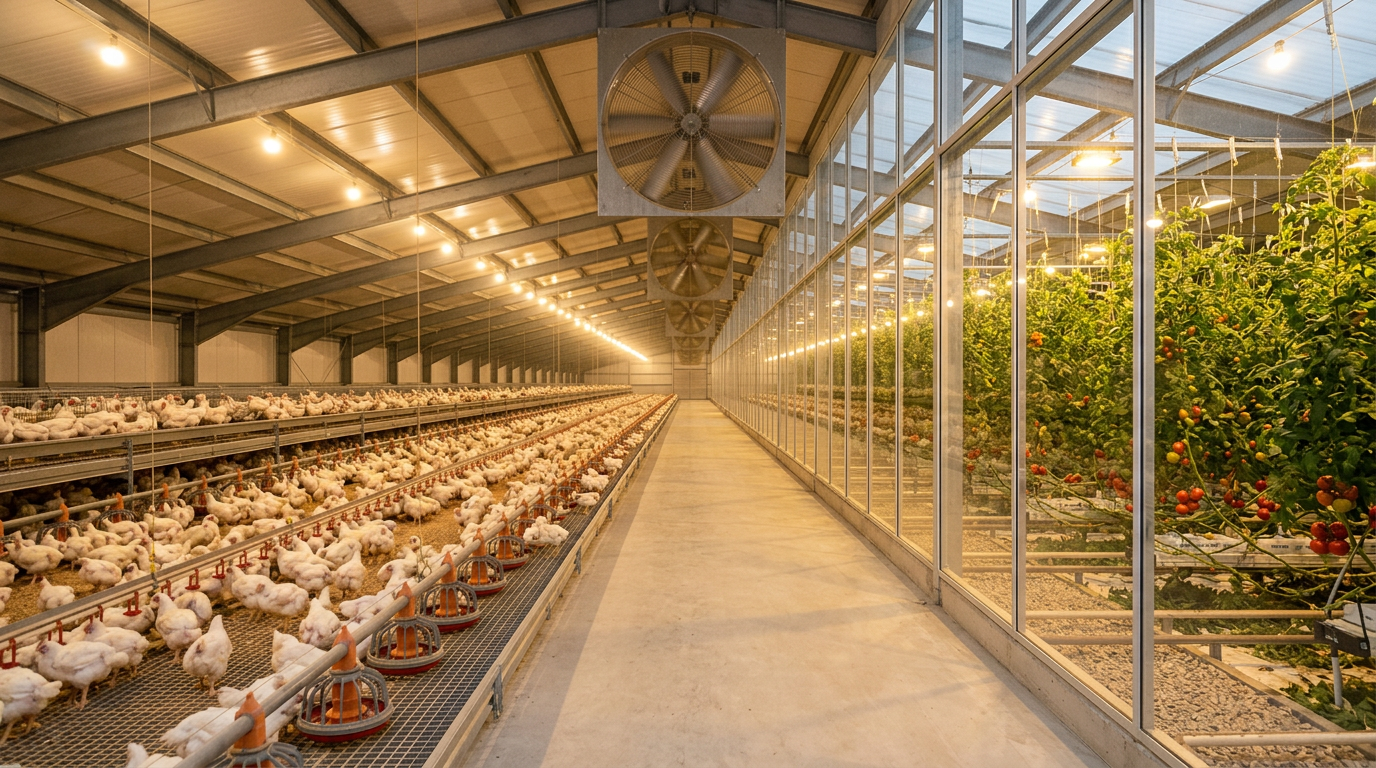
Poultry and greenhouse production are among the agricultural activities most dependent on controlled environmental conditions. In poultry houses where birds such as chickens, turkeys, and quails are raised, temperature, humidity, ammonia levels, and ventilation directly affect animal health, feed conversion ratios, and productivity indicators. In greenhouses, temperature, humidity, CO₂ levels, and lighting duration determine plant growth rates, fruit quality, and harvest cycles.
In both areas, even a few hours of environmental deviation can cause losses that are difficult to compensate. Excessive heat in poultry houses can lead to mass animal deaths, while failure to control day-night temperature differences in greenhouses leads to plant stress and yield reduction. Manual checks performed a few times a day by traditional methods remain insufficient, especially during night hours and seasonal transitions.
With Noctua software and BirSens hardware, all critical parameters in poultry and greenhouse environments are continuously monitored, instant notifications are sent when thresholds are exceeded, and historical data is reported. This enables producers to meet animal welfare standards, optimize plant yields, and reduce operational costs.
Instant monitoring of environmental conditions in poultry houses and greenhouses is indispensable for preventing animal losses, increasing plant yield, and keeping energy costs under control.
In poultry farming, animal welfare regulations and Good Agricultural Practices (GAP) mandate continuous monitoring and documentation of environmental conditions. In greenhouse production, climate control records are expected to be kept within the scope of GlobalG.A.P. certification. Therefore, not only instantaneous measurement but continuous data recording, alarm management, and audit-oriented reporting infrastructure are of great importance.
Furthermore, modern poultry and greenhouse enterprises are no longer limited to a single facility and have multiple production units. Monitoring poultry houses or greenhouse blocks at different locations through a centralized platform, early detection of anomalies, and efficient use of resources is one of the cornerstones of a growth strategy.
Key Risks Encountered in Poultry Houses and Greenhouses
Temperature Fluctuations
The ideal temperature in poultry houses should be kept in the 18-32°C range depending on the age and species of the animal. In greenhouses, controlled management of day-night temperature differences is critical for plant development. Failures in heating or cooling systems, sudden seasonal changes, or ventilation inadequacies can cause serious losses.
Humidity Imbalances
High humidity in poultry houses triggers respiratory diseases while low humidity causes increased dust and mucosal irritation. In greenhouses, excessive humidity brings mold and fungal diseases, while low humidity brings leaf burn and growth stunting. Maintaining the ideal humidity range continuously is vital for both areas.
Ventilation Inadequacy and Gas Accumulation
Accumulation of ammonia (NH₃) and carbon dioxide (CO₂) in poultry houses directly threatens animal health. Ammonia levels exceeding 25 ppm lead to respiratory problems and yield reduction. In greenhouses, CO₂ levels remaining both low and high affect photosynthesis efficiency. Failure of ventilation fans or shutters can cause these gases to reach dangerous levels.
Power and Heating Outages
Power outages cause ventilation, heating, cooling, and lighting systems to go offline simultaneously. Especially in winter months, a heating outage of a few hours in poultry houses can lead to mass deaths in chicks. Generator startup time and power status should be monitored instantaneously.
Lighting Irregularities
In poultry farming, the lighting program (photoperiod) is directly effective on egg yield and feed consumption. In greenhouses, additional lighting applications determine the timing of plant flowering and fruit set. Disruptions in lighting durations disturb the production cycle and cause economic loss.
Risk of Disease and Yield Loss
Environmental conditions not kept under control trigger respiratory infections and intestinal diseases in poultry houses, while preparing the ground for plant diseases such as mold, mildew, and root rot in greenhouses. Situations that cannot be intervened early can affect the entire flock or crop, causing large economic losses.
What Does Birtech Provide in This Area?
End-to-end solution from hardware to software, from alarm management to after-sales support:
Field-Proven Hardware
BirSens sensors and control modules designed for harsh environments containing high humidity, dust, and ammonia like poultry houses and greenhouses stand out with their IP protection class, corrosion resistance, and long-life features. Thanks to the integration of software and hardware, the system operates end-to-end with Birtech assurance.
All Parameters on a Single Screen
Temperature, humidity, ammonia, CO₂, lighting duration, ventilation fan status, and power presence are monitored simultaneously from a single platform. Each poultry house or greenhouse block can be configured independently; data is recorded with date and time stamps.
To the Right Person, at the Right Moment
Notification flows via email, SMS, and telephone calls are created for situations such as temperature deviation, ammonia threshold exceedance, fan failure, power loss, or lighting disruption. Tiered alarm scenarios can be defined for different roles such as night watchman, field supervisor, or plant manager.
Time-Based and Seasonal Alarm Rules
Custom rule definitions can be made for specific hours and days to prevent unnecessary alarm density during planned operations such as feeding, disinfection, or harvesting. Different temperature and humidity thresholds can be determined for summer and winter periods, ensuring alarm management compatible with seasonal conditions.
Smart Rules with Super Sensor
Logical alarm scenarios combining multiple conditions can be defined via Noctua software. For example: "If poultry house temperature exceeds 33°C AND ventilation fans are not running, GIVE CRITICAL ALARM" — with such rules, unnecessary notifications are prevented, and only real risks generate alarms. Similarly, both animal and plant health is proactively protected by establishing multi-condition scenarios like "If greenhouse humidity exceeds 90% AND ventilation shutters are closed, CALL the supervisor" or "If ammonia level exceeds 25 ppm AND the fan system has not been activated for 10 minutes, INFORM the emergency team."
2D Visualization and Heat Map
Poultry house and greenhouse areas can be visualized in 2D with Noctua. Where temperature differences occur, points where air circulation is insufficient, or areas with humidity accumulation are detected directly through the heat map. Thus, optimization decisions such as fan placement, curtain position, or heater capacity are made based on data.
Control Is Yours Even When in the Field
With Android and iOS applications, you can receive instant notifications from anywhere, view the status of all poultry house and greenhouse blocks, and quickly access basic reports. You can evaluate the situation from your phone when a critical alarm arrives during night hours.
Ready for Audit and Certification
Retrospective environmental condition reports for animal welfare audits, GAP (Good Agricultural Practices), and GlobalG.A.P. certifications are automatically generated. Sensor reliability can be documented with TURKAK-accredited calibration certificates.
Support That Ensures Continuity
Maintenance, calibration and support services provided under SensCare® protect the operational continuity of systems. Continuous support is provided to ensure the production cycle is not interrupted.
Reliability Is Proven in the Field
From poultry integrated facilities to greenhouse complexes, from egg production farms to seed greenhouses, Birtech infrastructure serves continuously in a wide range. Systems operating in the field for years are the most concrete proof of reliability.
Let Us Determine the Right Solution for You Together
Let us create a custom system architecture according to the number of poultry houses, number of greenhouse blocks, monitoring points, and certification needs. Submit your request, and our team will contact you as soon as possible.