Facility management encompasses the integrated monitoring and management of environmental conditions, energy consumption, and mechanical systems in large-scale structures such as factories, production lines, office buildings, data centers, logistics centers, and campus areas. Dozens of parameters such as temperature, humidity, air quality, power presence, water pressure, and lighting must be kept under control simultaneously.
Uncontrolled environmental conditions in facilities lead to decreased production quality, increased equipment failures, rising energy costs, and the emergence of occupational safety risks. Periodic checks performed with traditional methods remain insufficient, especially in large areas and multi-story structures; failures can only be detected after damage has occurred.
With Noctua software and BirSens hardware, all critical parameters throughout the facility are continuously monitored, instant notifications are sent when thresholds are exceeded, and historical data is reported. This enables facility managers to increase energy efficiency, optimize maintenance processes, and meet legal compliance requirements.
Instant monitoring of environmental conditions and energy consumption throughout the facility is of critical importance for increasing operational efficiency, preventing unexpected failures, and ensuring occupational safety standards.
In modern facilities, ISO 50001 Energy Management System, ISO 14001 Environmental Management System, and OHS (Occupational Health and Safety) legislation mandate continuous monitoring and documentation of environmental conditions. Green building certifications such as LEED and BREEAM also expect energy consumption, indoor air quality, and comfort parameters to be recorded. Therefore, not only instantaneous measurement but also continuous data recording, alarm management, and audit-oriented reporting infrastructure are of great importance.
Furthermore, large-scale enterprises are structures spread across multiple buildings, productions, and locations. Monitoring facilities in different regions through a centralized platform, early detection of anomalies, and efficient use of resources is a strategic necessity.
Key Risks Encountered in Facility Management
Temperature and Humidity Deviations
Temperature and humidity values going outside the determined range in production areas, server rooms, and storage regions cause product quality loss, electronic equipment failures, and material spoilage. Performance drops in air conditioning and heating systems generally progress unnoticed and can lead to large-scale damage.
Energy Consumption and Losses
Energy costs constitute one of the largest expense items in facilities. Not monitoring the energy consumption of air conditioning, lighting, ventilation, and production machines leads to unnecessary consumption, peak load penalties, and an increased carbon footprint. Failure to detect energy leaks and inefficiently operating equipment significantly raises operational costs.
Indoor Air Quality and Ventilation Problems
Increased levels of CO₂, VOC (volatile organic compounds), and particulate matter in office areas, production lines, and indoor parking lots threaten employee health and reduce work efficiency. Inadequate ventilation, clogged filters, or leaks in air ducts are problems that are frequently overlooked but have serious effects.
Water Leakage and Seepage Risks
Plumbing failures, roof leaks, or water accumulations caused by condensation throughout the facility can cause infrastructure damage, electrical contact, and production downtime. Early detection of water leakage is critical, especially in server rooms, archive areas, and chemical storage regions.
Mechanical Equipment Failures
Performance drops or unexpected failures of mechanical equipment such as air handling units, chiller units, pump stations, generators, and elevators cause production disruptions, loss of comfort, and high repair costs. Switching to data-driven predictive maintenance instead of a reactive maintenance approach significantly reduces failure rates and costs.
Occupational Safety and Compliance Risks
Situations such as excessive heat, inadequate ventilation, gas leaks, or fire risk may be subject to serious sanctions under OHS legislation. Continuous failure to monitor environmental conditions both jeopardizes employee health and causes problems in legal audit processes.
What Does Birtech Provide in This Area?
End-to-end solution from hardware to software, from alarm management to after-sales support:
Hardware Suitable for Industrial Environments
BirSens sensors and control modules designed for harsh conditions such as factories, warehouses, and technical infrastructure areas stand out with features such as wide measurement range, dust and moisture resistance, and long life. Thanks to software and hardware integrity, the system operates end-to-end with Birtech assurance.
Entire Facility on a Single Screen
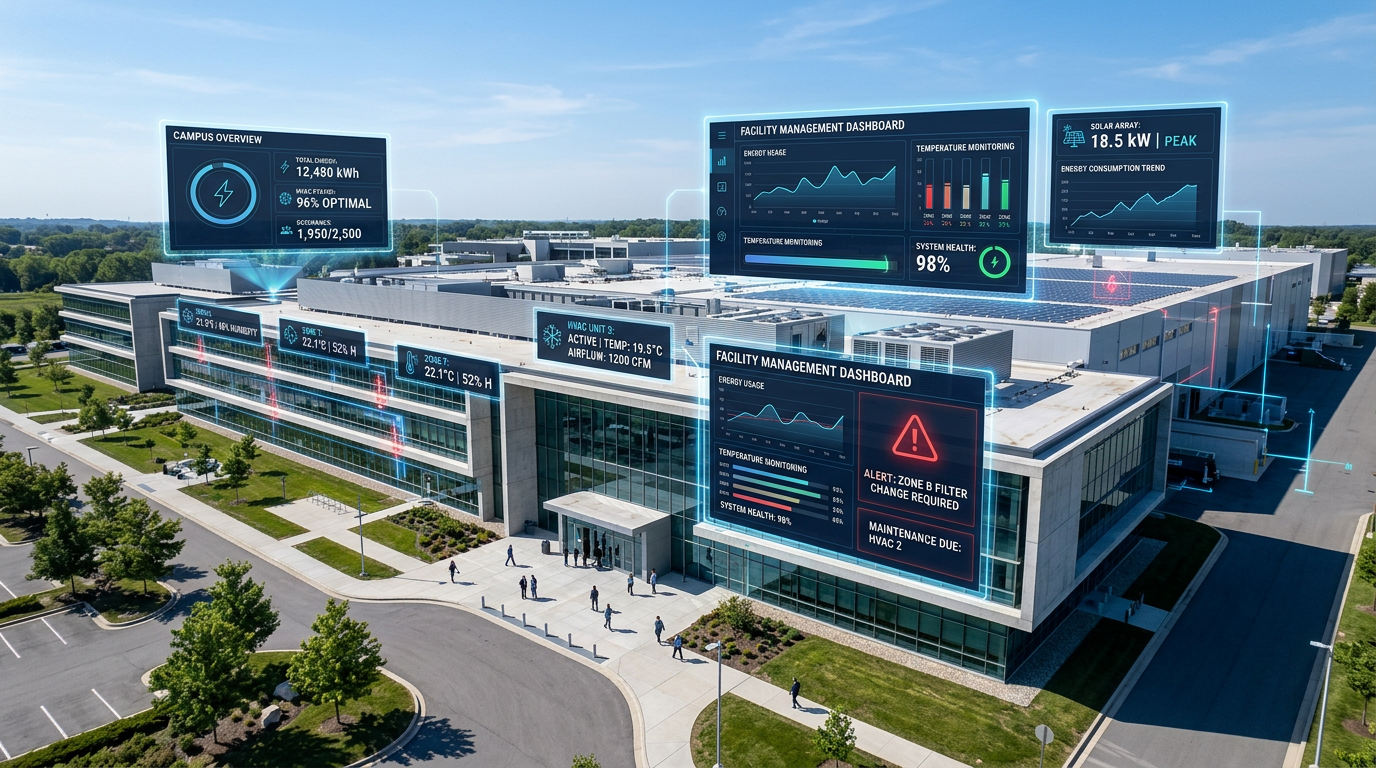
Temperature, humidity, energy consumption, water pressure, air quality, lighting level, and mechanical equipment status are monitored simultaneously from a single platform. Each building, floor, or region can be configured independently; data is recorded with date and time stamps.
To the Right Person, at the Right Moment
Notification flows via email, SMS, and telephone calls are created for situations such as temperature deviation, power outage, water leakage, air quality warning, or equipment failure. Tiered alarm scenarios can be defined for different roles such as technical team, shift supervisor, or facility manager.
Business and Shift-Based Alarm Rules
Custom rule definitions can be made for specific times to prevent unnecessary alarm density during production shifts, maintenance windows, or holidays. Different threshold values are determined for working hours and non-working periods, ensuring alarm management compatible with operational conditions.
Smart Rules with Super Sensor
Logical alarm scenarios combining multiple conditions can be defined via Noctua software. For example: "If server room temperature exceeds 28°C AND the air conditioner is not running, GIVE CRITICAL ALARM" — with such rules, unnecessary notifications are prevented, and only real risks generate alarms. Similarly, facility infrastructure is proactively protected by establishing multi-condition scenarios like "If energy consumption has increased by 30% AND the production line is closed, INFORM the energy manager" or "If basement humidity sensor exceeds 95% AND water leak sensor is active, CALL the emergency team."
2D Visualization and Heat Map
Facility areas can be visualized in 2D with Noctua. Where temperature differences occur, points where ventilation is insufficient, areas where energy consumption is concentrated, or regions with humidity accumulation are detected directly through the heat map. Thus, optimization decisions such as air conditioning capacity, air duct arrangement, or equipment placement are made based on data.
Control Is Yours Even When in the Field
With Android and iOS applications, you can receive instant notifications from anywhere, view the status of all facility regions, and quickly access basic reports. You can evaluate the situation from your phone when a critical alarm arrives during night hours or weekends.
Energy Analysis and Savings Reports
Energy consumption trends, peak load analyses, and region-based comparisons throughout the facility are automatically reported. Unnecessary energy spending in which time periods and regions is identified, and concrete savings opportunities are determined. ISO 50001 compliant energy management reports can be easily generated.
Ready for Audit and Certification
Retrospective environmental condition and energy consumption reports for ISO 50001, ISO 14001, OHS legislation, and green building certifications (LEED, BREEAM) are automatically generated. Sensor reliability can be documented with TURKAK-accredited calibration certificates.
Support That Ensures Continuity
Maintenance, calibration and support services provided under SensCare® protect the operational continuity of systems. Continuous support is provided to ensure the facility's production cycle is not interrupted.
Reliability Is Proven in the Field
Birtech infrastructure serves continuously in a wide range from production facilities to office buildings, from logistics centers to data centers. Systems operating in the field for years are the most concrete proof of reliability.
Let Us Design the Solution Tailored to Your Facility
Let us create a custom system architecture according to facility size, number of buildings, monitoring points, and certification needs. Submit your request, and our team will contact you as soon as possible.