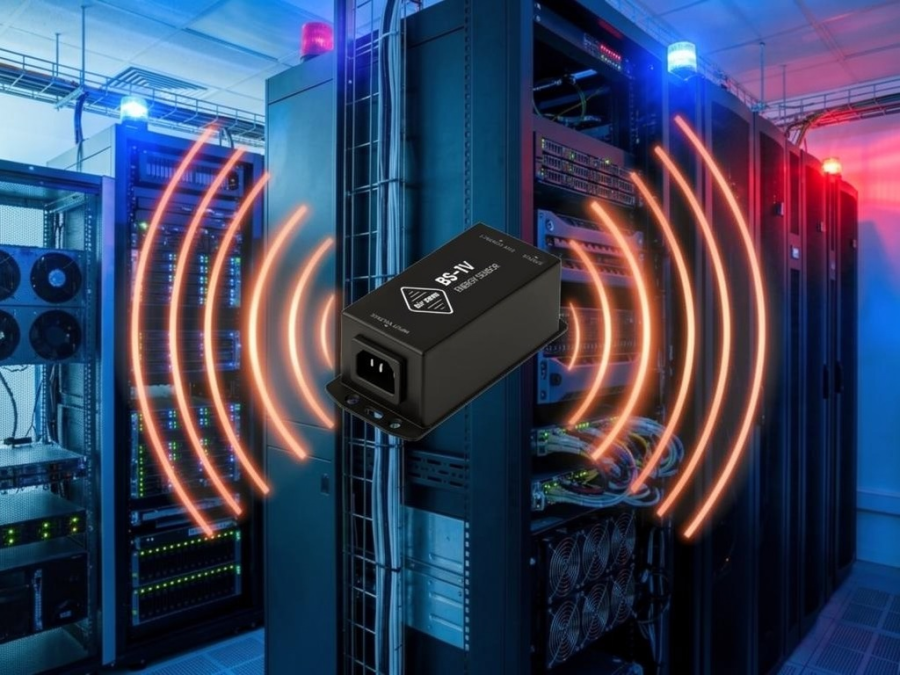
A voltage sensor measures the electrical potential difference between two points and sends the reading to a monitoring system. The device reads the power input on the line (AC or DC), compares it against defined thresholds, and converts the status into a digital signal. In server room scenarios, the most common requirement is continuous tracking of whether grid voltage stays within the expected band.
Birtech power sensors use an architecture based on voltage presence and operating range. The sensor monitors the line, and the output contact changes state when voltage moves outside the defined band or cuts off completely. The output signal reaches a BirSens environmental monitoring module through Normally Closed (NC) dry contact logic.
Dry Contact (NC) Logic
BS-1V and BS-2V hardware operate on the Normally Closed (NC) dry contact communication protocol. This protocol produces three states:
- Voltage within the normal band: The contact stays closed, producing a "normal" status.
- Voltage outside the band or a complete outage: The contact opens, producing an "alarm" status.
- Broken cable or sensor fault: The contact opens, producing an "alarm" status (fail-safe).
Critical infrastructure favors NC logic because it also treats a broken cable or a sensor fault as an alarm condition. The sensor reports the observed status to the module; the threshold-based alarm decision and notification generation happen entirely in the software layer.
AC/DC Measurement Differences
The difference between alternating current (AC) and direct current (DC) measurement is the first criterion in sensor selection. Grid supply runs on alternating current (AC), while battery banks, rectifier outputs, and DC distribution panels carry direct current (DC). Birtech's BS-1V and BS-2V devices are built for AC grid lines and operate on 100–240 VAC and 220 VAC supply, respectively. Identifying the line type correctly is mandatory for both measurement accuracy and personnel safety. Galvanic isolation on AC measurement lines separates the measurement circuit from the low-voltage signal line, enabling safe data transfer.
The Hidden Cost of Voltage Fluctuations in Critical Facilities
Voltage fluctuations are often invisible to the eye, yet their impact shows up as hardware failure, data loss, and unplanned downtime. Facilities face two core risks:
- Overvoltage: When line voltage rises above the nominal value, power supplies, motherboards, and driver circuits become overloaded. A single voltage spike can burn out a power supply board within minutes.
- Brownout: When grid voltage drops below the nominal value, devices do not shut down completely. Instead, they experience unexpected restarts, disk write errors, and data corruption. A brownout is more deceptive than a sudden total outage. Most monitoring systems only track "power on / power off" data, so they miss the gradual decline.
Measuring grid voltage matters as much as measuring temperature. A temperature sensor reports the thermal condition of the environment, while a voltage sensor reports the health of the power feeding that environment. Together, the two create a facility's real risk map.
Voltage Fluctuation Risk Analysis Table
Use Cases in Industrial and IT Environments
A voltage sensor delivers concrete value at every point where power is critical. Accurate telemetry data safeguards the following operational processes:
- Data Centers: Monitoring the input supply ahead of the UPS catches grid-related problems before they drain the UPS battery. When the UPS takes over, power appears to continue uninterrupted, but an outage on the input line quietly consumes battery runtime. A voltage sensor placed on the input line immediately triggers a "grid down, battery runtime in use" alert.
- Telecom Base Stations: Confirming that battery banks receive the correct voltage is the leading cause of field outages. Low voltage on the charging supply line prevents batteries from reaching a full charge and leaves nighttime power supply insufficient.
- Cold Chain and Logistics: Confirming that industrial refrigerators and cold storage facilities receive stable power is mandatory for product safety. A BS-1V sensor connected to the supply line detects when the compressor loses power and alerts the team before product temperature rises.
- Technical Service and Power Rooms: Monitoring panels and distribution lines brings remote tracking of power rooms into a central console, reducing staff dependence on physical inspection rounds.
Grid voltage monitoring rests on one shared principle across every scenario above: power stays invisible until it stops. A voltage sensor makes that flow of energy visible in real time.
BirSens Voltage Sensors: Accurate Measurement and IoT Integration
Birtech covers power monitoring needs with two device classes. Both products work with BirSens environmental monitoring modules and connect to Sensaway software.
1. BS-1V Power Presence Sensor
The BS-1V Power Presence Sensor tracks whether power is present on a line in real time. Its wide 100–240 VAC operating range makes the hardware usable across different supply lines. When the grid cuts off or line voltage moves outside the band, the sensor detects the change. It sends a power-outage signal to the module through the dry contact. Its compact housing (60 × 45 × 130 mm, 115 g) suits both panel and enclosure mounting.
2. BS-2V Power On/Off Control Sensor
The BS-2V Power On/Off Control Sensor adds remote on/off control for a connected load, alongside power-presence monitoring. It watches a 200–230 VAC operating band on a 220 VAC supply, and any value outside that band triggers an alarm. The remote on/off feature lets you power-cycle a frozen device by cutting and restoring its power remotely, without a site visit.
BS-1V and BS-2V Technical Comparison Table
IoT Voltage Measurement and Module Architecture
In IoT voltage measurement architecture, the sensor never decides anything on its own. BS-1V and BS-2V carry the observed status to the BirSens module as a dry contact signal, and the module passes that signal on to the software layer. This hardware-independent architecture keeps the sensor low-cost. It also lets the sensor combine with temperature, humidity, and water sensors from the environmental monitoring catalog on the same module.
Threshold-Based Alarm Management and Central Software Compatibility
Sensor data gains meaning only when interpreted correctly. Threshold-based alarm management is the layer that turns raw voltage status into action. When voltage drops below the defined range, the central software starts an alert chain. The team learns about the condition before a total outage occurs. Sensaway Monitoring and Management Software displays BS-1V and BS-2V data in real time and generates rule-based notifications.
Notification channels operate across the following layers:
- NC Dry Contact: Carries power status from the sensor to the BirSens module.
- LCD Text/Light Alert: Provides visual and audible warning through the BirSens module.
- Email: Delivers list-based notifications through Sensaway software.
- Audible Alert: Warns the monitoring center at the operator console.
- Siren Module: Creates an instant alert for field staff through BirSens integration.
- SMS and Voice Call: Delivers critical after-hours notifications through the SMS module.
- Mobile App: Sends instant push notifications to smartphones.
Typical Automation Scenario
- Grid voltage drops below 200 V.
- The BS-2V moves outside its operating band, and its NC dry contact opens.
- The BirSens module displays a text and light warning on its LCD.
- Sensaway software classifies the event according to a predefined rule:
- During business hours: An audible alert sounds at the operator console, and an email goes out.
- After hours: The SMS module calls the on-duty staff member, and an instant notification goes to the mobile app.
- Recurring event: The alert level escalates and the event logs to the trend report.
- If a total outage occurs, the BS-1V's "power off" alarm confirms that UPS battery runtime is in use.
Frequently Asked Questions
What Is the Difference Between AC and DC Voltage Sensors?
An AC voltage sensor measures the voltage difference on an alternating current line, where direction and magnitude change periodically; grid supply falls into this category. A DC voltage sensor measures the voltage difference on a fixed-direction direct current line, such as a battery bank or a rectifier output. Birtech's BS-1V and BS-2V are built for AC grid lines.
Why Monitor Voltage Fluctuations with a Sensor When a UPS Is in Place?
A UPS powers the load during an outage, but it does not directly report the status of the power input to an administrator. When grid power goes down, energy appears to continue, while battery runtime quietly drains in the background. A voltage sensor placed on the input line immediately triggers a "grid down, battery runtime in use" alert.
Does Sensor Installation Require a Power Outage?
For installations that connect to the power line in series or in parallel, cutting power to that line is standard procedure for personnel safety. The installation plan determines in advance which panel goes offline and for how long.
What Does the BS-2V's Remote On/Off Feature Do?
The BS-2V sensor performs a power cycle by remotely cutting and restoring power to a frozen device. This feature shortens response time significantly.
Does a Voltage Sensor Generate Alarms on Its Own?
No. The BS-1V and BS-2V sensors send status information to the BirSens module through the NC dry contact. Alarm generation, threshold decisions, and notification delivery all happen in the Sensaway software layer.