ASHRAE A1 is the narrowest temperature and humidity tolerance class for server and storage equipment. ASHRAE standards divide data center equipment into four main classes: A1, A2, A3, and A4. Each class carries a different allowable temperature envelope, a different humidity limit, and a different typical use case.
The difference between these four classes shapes cooling system design directly. Tight-tolerance A1 equipment requires strict climate control. Wide-tolerance A4 equipment runs on free cooling and consumes less energy. The table below compares the temperature, dew point, and humidity limits of all four classes.
What Is ASHRAE TC 9.9?
ASHRAE TC 9.9 is the technical committee within the American Society of Heating, Refrigerating and Air-Conditioning Engineers that standardizes environmental conditions for data centers and mission-critical facilities. The committee defines temperature and humidity limits for IT equipment in its "Thermal Guidelines for Data Processing Environments," now in its 5th edition, published in 2021.
The classification works on two layers: the recommended envelope and the allowable envelope. The recommended envelope is the target range where equipment runs reliably and efficiently over the long term. The allowable envelope is the wider boundary equipment can tolerate without damage during temporary conditions, such as a cooling system failure.
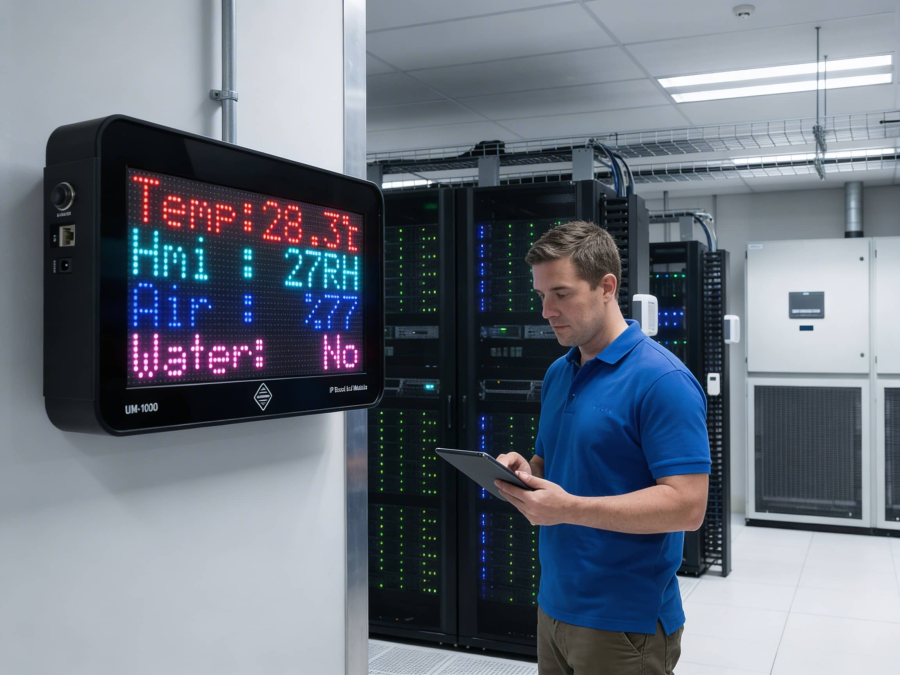
Server room and data center projects in Turkey install temperature and humidity sensor solutions to monitor both envelopes continuously.
Recommended Envelope: 18–27°C Temperature and Dew Point Limits
The recommended envelope is the same across all four classes, from A1 to A4, and it is the starting point for data center temperature range planning. ASHRAE sets this range to balance energy efficiency against equipment reliability.
Temperature Range: 18°C – 27°C
Server inlet temperature stays between 18°C and 27°C. Temperature below the lower limit consumes extra cooling energy without benefit. Temperature above the upper limit lowers equipment reliability and raises the risk of thermal throttling. The temperature gradient inside a rack can reach several degrees between the bottom and top unit, so a single sensor cannot measure it on its own.
Humidity and Dew Point Limit
The upper humidity limit of the recommended envelope is 60% relative humidity. The lower limit is the higher of -9°C dew point and 8% relative humidity. Starting with the 5th edition, ASHRAE shifted the primary humidity metric from relative humidity to dew point; dew point reflects electrostatic discharge and condensation risk more consistently than relative humidity. A -9°C dew point is low enough to control static discharge risk and removes the need for humidification equipment in most climates.
ASHRAE A1, A2, A3, A4 Allowable Envelope Comparison
The allowable envelope widens from class to class. ASHRAE A1 carries the narrowest tolerance; ASHRAE A4 carries the widest. The table below compares the allowable temperature range, maximum dew point, and maximum relative humidity of the four classes. The humidity lower limit is the same across all classes: the higher of -12°C dew point and 8% relative humidity.
Values are based on the allowable envelope definitions in ASHRAE TC 9.9 Thermal Guidelines for Data Processing Environments (5th edition).
What Is ASHRAE A1 Class?
ASHRAE A1 class covers enterprise servers and enterprise storage systems. The allowable temperature range is 15°C to 32°C. The maximum dew point is 17°C, and the maximum relative humidity is 80%. Banking server rooms and critical infrastructure that require continuous operation typically target ASHRAE A1; this class carries the narrowest tolerance and leaves the least room for climate control deviation.
What Is ASHRAE A2 Class?
ASHRAE A2 class covers high-end commercial servers. The allowable temperature range widens to 10°C through 35°C. The maximum dew point is 21°C, and the maximum relative humidity is 80%. The wider tolerance compared to A1 lets the cooling system extend free cooling hours and lower energy consumption.
What Is ASHRAE A3 Class?
ASHRAE A3 class covers volume-deployment servers and storage products. The allowable temperature range is 5°C to 40°C. The maximum dew point is 24°C, and the maximum relative humidity is 85%. At altitudes above 900 meters, the allowable upper temperature limit for A3 equipment derates by 1°C per 175 meters. Facilities at high altitude factor this derating into their cooling capacity calculations.
What Is ASHRAE A4 Class?
ASHRAE A4 class is defined for custom-designed servers and edge computing equipment. The allowable temperature range extends to 5°C through 45°C, the widest tolerance among the four classes. The maximum dew point is 24°C, and the maximum relative humidity is 90%. Above 900 meters, the derating rate is steeper than A3: 1°C per 125 meters. A4 equipment is preferred in edge facilities with no or minimal air conditioning.
Altitude and Rate-of-Change Limits
ASHRAE places two additional constraints alongside the temperature envelope: altitude-based derating and the rate of change over time. Both directly affect measurement and alarm rules.
Altitude-Based Temperature Derating
As facility altitude increases, air density drops and cooling efficiency falls. ASHRAE compensates for this by lowering the allowable upper temperature limit at facilities above 900 meters. Class A3 derates by 1°C per 175 meters. Class A4 derates by 1°C per 125 meters, a faster drop than A3. In a high-altitude server room, the real allowable upper limit runs lower than the value in the table.
Hourly and 15-Minute Temperature Change Limit
The rate of temperature change is limited across all classes. Hourly change cannot exceed 20°C, and change within any 15-minute window cannot exceed 5°C. Tape storage systems carry a tighter limit: 5°C per hour at most. This limit protects equipment from thermal shock during cooling system transitions or failure scenarios, and it sets the threshold for trend alarms in monitoring software.
Which Class Fits Your Server Room?
Class selection comes from the equipment manufacturer's datasheet; a facility operator does not choose the class, they design cooling around the class the equipment already carries.
Enterprise and Critical Server Rooms
Banking, healthcare, and server rooms that require continuous operation typically house ASHRAE A1 or A2 class equipment. The cooling system runs continuously to hold the narrow tolerance in these environments, and temperature sensors report data at short intervals.
Free-Cooling and Edge Facilities
Edge facilities operating across a wide altitude range and data centers pursuing a free-cooling strategy prefer ASHRAE A3 or A4 class equipment. The wide temperature tolerance extends outside-air cooling hours and lowers mechanical cooling energy.
Verifying ASHRAE Compliance Through Measurement
A class definition stays on paper unless a server room's actual temperature and humidity values are measured continuously; ASHRAE compliance cannot be verified without it. The BS-2S Temperature Sensor measures -40°C to +70°C at 0.5°C accuracy. The BS-2SN Temperature and Humidity Sensor covers the same temperature range plus 0% to 100% RH at 1.8% RH accuracy. This 0.5°C accuracy matches the tolerance level widely accepted for server inlet temperature measurement.
Setting Alarm Thresholds Against Class Limits
Sensaway Monitoring and Management Software sets a separate upper and lower threshold for each measurement point. A threshold set against the recommended envelope of the selected class produces an early warning; a threshold set against the allowable envelope triggers only at a critical condition. Defining both thresholds together is common practice: an informational alarm at a recommended-envelope breach, a critical alarm at an allowable-envelope breach. Noctua Smart Infrastructure Management manages these thresholds from a central panel across multi-room projects.
For a general overview of ASHRAE standards, the server room temperature ASHRAE standards article is also a useful reference.
Frequently Asked Questions
What is the difference between ASHRAE A1 and A2 class?
Both classes share the same recommended envelope: 18°C to 27°C. The difference appears in the allowable envelope. ASHRAE A1 stays within 15°C to 32°C, while ASHRAE A2 widens to 10°C through 35°C. The maximum dew point for A2 is 21°C; for A1, it is 17°C. The wider tolerance lets A2 equipment use more free-cooling hours.
Which ASHRAE class should a server room target?
The target class comes from the manufacturer's datasheet for the equipment in the room. A mixed server room targets the class of its narrowest-tolerance equipment, because the cooling system has to protect the most sensitive device. When the class of every device in the inventory is unknown, the default target is the ASHRAE A1 recommended envelope.
Why is dew point considered a more reliable indicator than relative humidity?
Relative humidity changes with temperature, so the same amount of moisture reads as a different relative humidity percentage at different temperatures. Dew point reflects the absolute amount of water vapor in the air directly and stays constant even as temperature changes. Condensation and electrostatic discharge risk are tracked more consistently through dew point for this reason.
How does altitude affect the server room temperature limit?
No derating applies below 900 meters. Above 900 meters, ASHRAE A3 class derates by 1°C every 175 meters, and ASHRAE A4 class derates by 1°C every 125 meters. A server room in a high-altitude city operates at a real upper limit lower than the nominal value in the table.
Which facilities prefer ASHRAE A3 and A4 class?
These two classes, with their wide temperature and humidity tolerance, suit facilities that want to reduce mechanical cooling and extend outside-air cooling hours. Edge data centers, containerized server rooms, and sites with limited air conditioning are the typical use cases for these classes.
Pre-Installation Checklist
Complete the following steps before you start monitoring ASHRAE class compliance:
- Verify the ASHRAE class (A1–A4) of the equipment in the server room from the manufacturer's datasheet.
- Size cooling capacity to hold inlet temperature within the 18–27°C recommended envelope.
- Position temperature and humidity sensors at the rack inlet, at a minimum of two different heights.
- Factor the derating rate of the selected class into the cooling calculation if facility altitude exceeds 900 meters.
- Define separate alarm thresholds for the recommended envelope and the allowable envelope.
- Test an HVAC transition scenario that keeps hourly temperature change under the 20°C limit.
This content draws on field experience from data center and server room environmental monitoring projects. Class definitions and limit values reference ASHRAE TC 9.9 Thermal Guidelines for Data Processing Environments (5th edition, 2021). Product values come from the BS-2S and BS-2SN datasheets. Reference standard: ASHRAE TC 9.9 A1–A4 Equipment Classes.