An SMS module converts the alarm signal a sensor produces into an SMS message or a voice call over the GSM network. When a temperature threshold is exceeded in a server room or a water sensor detects a leak, email or mobile notifications do not always reach off-site personnel fast enough. The central SMS module closes this gap over the GSM network and opens a separate notification channel that does not depend on the organization's internet connection.
Birtech manufactures three central SMS modules: the BS-865T, the BS-978T, and the BS-980T. All three communicate directly with Sensaway monitoring and management software and manage alarms for multiple locations with a single device and a single SIM card. This article compares the connection method, battery support, and model selection criteria of the three models using datasheet data.
What Is an SMS Module and How Does It Work?
An SMS module does not make decisions on its own. A temperature, humidity, water, or door sensor in the system sends its measured value to the BirSens module; when the threshold is exceeded, the Sensaway software classifies the event and runs the notification rule. The SMS module takes over at this point. It receives the command from the software and connects to the GSM network through its built-in SIM card. It sends an SMS alarm message or starts a voice call to the defined numbers.
The organization supplies the SIM card and the carrier subscription plan required to send notifications. The module hardware runs the SMS and call function; the line and plan choice depends on the organization's mobile carrier preference.
How Does a Remote Notification System Work Over GSM?
As a remote notification system, an SMS module works as long as GSM carrier coverage is available. Email and push notifications depend on internet access, while SMS messages and voice calls travel over the mobile network. This difference makes the SMS module a separate security layer when the corporate internet connection goes down. Remote monitoring and notification management principles tie the SMS channel together with email and the mobile app into a single notification plan.
USB vs. Ethernet Connection
The three models connect to Sensaway software in two different ways:
- BS-865T communicates with the Sensaway software on the server it connects to via USB. The connection is tied to a single server and suits a single location.
- BS-978T and BS-980T connect to the network over Ethernet (IP). All locations on the same network are managed through a single device, and the module is configured remotely from a web interface.
Why Is a Central SMS Module Necessary?
An alarm has value not just when it is generated but when it reaches the right person at the right moment. Outside working hours or on weekends, no operator watches the server room continuously. A temperature or water alarm can sit in an email inbox, while SMS and voice calls reach the on-call staff's phone directly. A notification chain built with the correct threshold and delay values follows rules that prevent alarm fatigue and sends an SMS only for an actual risk.
The Role of SMS When Email and Push Notifications Fall Short
When the email server goes down or the corporate internet line is cut, software-based notification channels stop working. GSM alarm notification keeps working in this scenario because the SMS module uses the mobile carrier network. The BS-865T also works as a voice call module and reaches on-call personnel with a spoken alert over the GSM line.
Sabotage and Software Outage Notification
The BS-978T and BS-980T send notifications even when the Sensaway software itself is not running. When the software server goes down or the device is sabotaged, the module detects the condition independently and generates an alert by SMS, call, or email. The BS-865T datasheet does not list this independent alert feature.
BS-865T vs. BS-978T vs. BS-980T Comparison
All three models perform the same core function: converting a sensor alarm into an SMS or a call. The difference between them shows up in the connection method, battery support, and status display type.
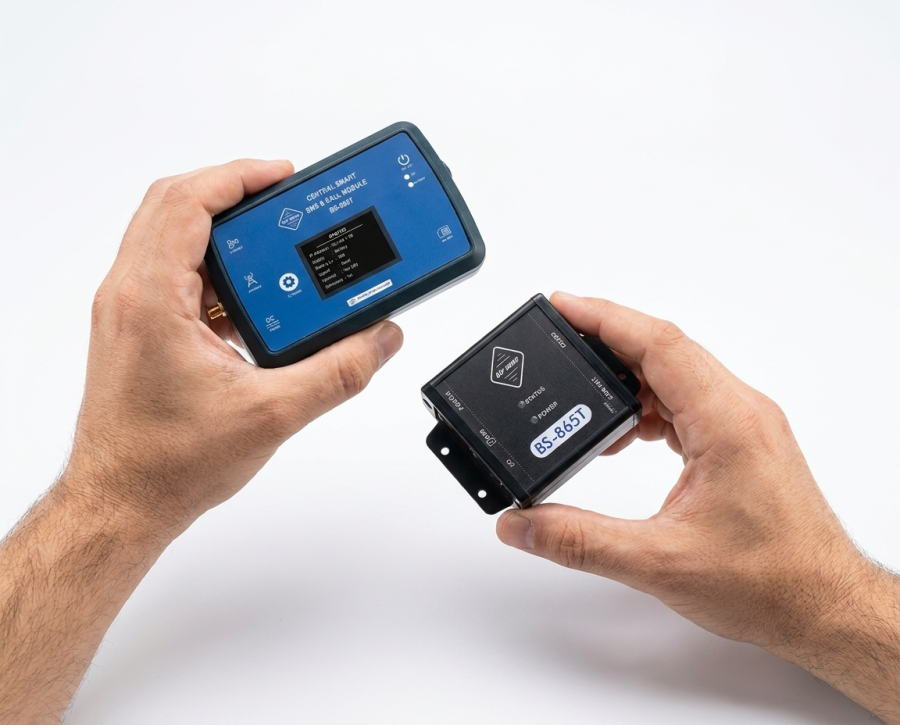
BS-865T: Standard Central SMS and Call Module
BS-865T Standard Central SMS and Call Module is the entry-level model that connects to a single server over USB. Its enclosure measures 82 × 84 × 32 mm and weighs 200 g. It has 2 status LEDs that show Power and GSM status. The device runs on 5 Volts and operates between -40 °C and +85 °C at 0–85% relative humidity. It suits wall or desktop mounting; an installation guide, a 5V DC adapter, and an external GSM antenna ship as accessories.
BS-978T: Smart Central SMS and Call Module
BS-978T Smart Central SMS and Call Module connects to the network over Ethernet and is managed from a web interface. Its 10/100 Ethernet connection is secured with password protection and IP address filtering. A built-in 3.7V 900 mAh Li-Polymer battery keeps sending notifications for up to 6 hours during a power outage. The modem supports the 800/900 MHz and 1700/1900/2100 MHz bands. Status is shown through 5 separate LEDs: Power, wireless, GSM, Sensaway, and Ethernet. Its enclosure measures 205 × 145 × 48 mm and weighs 270 g.
BS-980T: Smart Central SMS and Call Module v2
BS-980T Smart Central SMS and Call Module is the newest and most fully equipped model in the series. Its Ethernet connection, password protection, and IP filtering features match the BS-978T. Status is shown on a 320 × 240 pixel TFT LCD screen; besides the screen, it has 2 status LEDs, green and yellow, that show power status. The built-in battery is a 3.7V 1,800 mAh Li-Polymer unit and keeps sending notifications for up to 6 hours during a power outage. The modem supports 4G LTE-FDD and works on the GSM/GPRS/EDGE 900/1800 MHz bands. The device requires a 12 Volt / 2A power input; its enclosure measures 140 × 100 × 48 mm and weighs 220 g.
Technical Comparison Table
Criteria for Choosing the Right SMS Module
Model choice depends on the answers to three questions: how many locations need monitoring, whether notification during a power outage is required, and which notification channel is needed.
Number of Locations and Network Structure
For single-location setups tied to one server, the BS-865T is enough, and its USB connection requires no extra network configuration. When multiple locations on the same corporate network need monitoring, the BS-978T or BS-980T is the better choice; the Ethernet connection lets a single SIM card and a single console manage all locations.
Power Outage Tolerance
If notifications must still go out during a grid outage, the BS-978T or BS-980T is the right choice. Both models generate notifications for up to 6 hours on their built-in battery. The BS-865T's specification list does not include built-in battery support.
Notification Channel Needs
All three models send SMS messages and voice calls to an unlimited number of users. The BS-978T and BS-980T also activate the email channel during a power outage, sabotage, or software outage. If SMS and calls alone are enough, choose the BS-865T; if an email layer is also needed, choose the BS-978T or BS-980T.
Installation and Network Security Notes
SIM Card and Subscription Requirements
The organization supplies the SIM card and mobile subscription plan required for notifications through its own carrier agreement. The module hardware connects the line to the GSM network and handles generating SMS alarms and voice calls.
Network Security on Ethernet Models
Because the BS-978T and BS-980T operate on the network, password protection and IP address filtering settings are enabled during installation. Filtering allows only authorized management stations to access the module's web interface.
Antenna and Mounting Location
In weak-signal areas such as a metal cabinet or a basement floor, the external GSM antenna is routed outside the module. The antenna is placed at a point with stronger coverage. Wall and desktop mounting options let the module fit into a server room or panel installation.
Frequently Asked Questions
How many users can an SMS module notify?
All three models send SMS messages or make calls to an unlimited number of users. The list of recipients and the call order are defined through the Sensaway software.
Does an SMS module work without internet?
SMS and voice calls travel over the GSM carrier network, a channel independent of the corporate internet connection. For the module to receive the alarm command, however, its connection to the Sensaway software must stay open; this connection runs over USB on the BS-865T and over Ethernet on the BS-978T and BS-980T.
What is the main difference between the BS-978T and the BS-980T?
The BS-980T comes with a 320×240 pixel TFT LCD screen, a 4G LTE-FDD modem, and a higher-capacity battery (1,800 mAh). The BS-978T uses 5 status LEDs instead of a screen and works with a 3G modem. Both models offer an Ethernet connection, network security, and up to 6 hours of battery support.
Can an SMS module send notifications during a power outage?
The BS-978T and BS-980T keep sending notifications for up to 6 hours during a power outage thanks to their built-in Li-Polymer battery. The BS-865T datasheet does not list such a battery feature.
In which scenario is the BS-865T enough?
The BS-865T is enough for simple, single-location setups that connect to one server over USB and need no extra network configuration. When multiple locations or notification during a power outage is needed, the BS-978T or BS-980T is the better choice.
Pre-Installation Checklist
- SIM card and carrier subscription plan required for sending notifications obtained
- GSM signal coverage tested at the installation location
- IP address, password protection, and filtering settings determined for Ethernet models (BS-978T / BS-980T)
- Server with Sensaway software installed identified for the USB-connected model (BS-865T)
- List of personnel to notify and call order defined in the Sensaway software
- Correct power adapter obtained (5V: BS-865T / BS-978T, 12V-2A: BS-980T)
- Mounting location with strong signal identified for the external GSM antenna
This content draws on field experience gained from GSM-based central alarm notification installations. Technical values come from the manufacturer datasheets for the BS-865T, BS-978T, and BS-980T. On Ethernet-connected models, authorized IT staff should confirm that password protection and IP address filtering settings are configured to match the organization's network security policy.