Environmental Monitoring
What is Alarm Fatigue? How Can Effective Alarm Rules Be Created in a Data Centre?
17 April, 2026
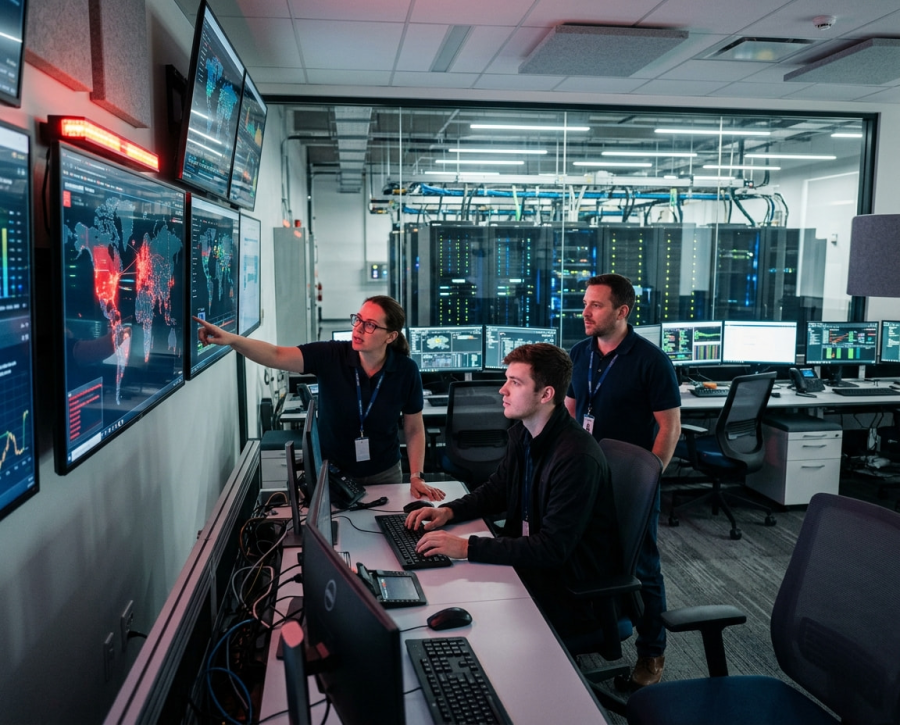
The smartphones of on-duty engineers in data centre network operations centres (NOCs) receive thousands of SMS and email notifications every day. Critical IT infrastructures send periodic status updates. Traditional monitoring platforms convert even the slightest sensor fluctuation into an error message labelled ‘Critical’. Marking every event in the system as ‘Critical’ creates the impression that no event is critical. Noctua’s intelligent filtering engine permanently stops the flood of meaningless notifications on NOC screens. The software platform converts raw hardware data into actionable and precise root-cause analyses.
'Noise Pollution' in Data Centres: Sources of False Alarms (False Positives)
Table 1: Traditional Static Alarms vs. Noctua Smart Alarm Rules
Noctua Smart Alarm and Event Management module reduce the cognitive load on operators. System administrators report ‘Noise Reduction’ rates to the management dashboard. Incident response teams focus solely on ten verified root-cause scenarios, rather than processing ten thousand pieces of raw data each month. Savings in time and labour ease the strain on businesses’ operational budgets. Rather than putting out fires in times of crisis, infrastructure teams can focus on designing the data centre architectures of the future.
Frequently Asked Questions (FAQ)
What is Alarm Fatigue and What Are the Operational Risks?
The fact that network administrators in data centres are constantly exposed to meaningless and repetitive error messages from thousands of different environmental sensors dulls the amygdala-based threat detection mechanisms in the human brain, leading operators to perceive hardware failures as mere background noise, whilst at the same time, it prevents the detection of thermal runaway scenarios triggered by the shutdown of cooling units, thereby paving the way for the complete collapse of the systems.
The medical and aviation literature defines the ‘Cry Wolf’ syndrome using the concept of ‘alarm fatigue’. NOC engineers constantly experience cognitive overload whilst working at their screens. After a while, operators mute the sounds of the red flashing lights. Engineers set up rules in their email clients to hide warning messages in the ‘Read’ folder. When a genuine and catastrophic hardware failure occurs, on-duty staff lose sight of the critical alert amongst hundreds of trivial messages. Server hardware worth millions of dollars is scorched by excessive heat. Service Level Agreements (SLAs) are breached within hours. Customers suffer irreversible data loss.
Boards of directors pass the bill for infrastructure disasters on to the IT department. Human error is not the root cause of these disasters. System architects design the alert infrastructure incorrectly. Software that lacks any filtering mechanism is of no help to operations teams. An excessive barrage of alerts is an architectural design flaw that directly threatens facility security.
'Noise Pollution' in Data Centres: Sources of False Alarms (False Positives)
Traditional monitoring platforms interpret momentary voltage fluctuations or network delays of a few seconds—read from hardware sensors—as permanent hardware failures, flooding central management screens with hundreds of error codes simultaneously; this creates a massive amount of noise pollution (noise pollution) that completely eliminates operational visibility within the data centre and critically prolongs the time it takes for engineers to identify the actual problem.
Dumb monitoring systems do not use logical filters. Analogue hardware sensors detect electromagnetic interference (noise) within the facility. An ambient temperature sensor measures a millisecond-long electrical disturbance as 80°C. Simple monitoring software instantly converts the reading into a ‘Fire Hazard’ alert. Managers are jolted awake in the middle of the night. When the teams arrive at the data centre, they find that the ambient temperature has remained stable at 21°C. Time and again, the teams fall victim to false alarms.
Scheduled maintenance work causes massive disruption to the network backbone. The network engineer reboots the core router for a software update. Hundreds of servers behind the router instantly generate connection-loss packets. The monitoring screen fills with thousands of red lines within seconds. Static thresholds cause constant fluctuations in the infrastructure. The administrator sets the temperature threshold to 25°C. The sensor reading rises to 25.1°C. The system immediately sends an SMS. The air-conditioning (CRAC) fan switches on. The reading drops to 24.9°C. The system suppresses the alert. Two minutes later, the temperature rises again to 25.1°C. The system sends another SMS. This vicious cycle, known as ‘flapping’, paralyses the NOC communication network.
How to Create Effective Alarm Rules? (The Noctua Engineering Approach)
How to Create Effective Alarm Rules? (The Noctua Engineering Approach)
Developed by the Noctua platform to stem the flood of meaningless alerts that organisations face when managing their cyber infrastructure and to transform crisis management into an autonomous engineering discipline, the dynamic filtering algorithms combine physical sensor data with logical timestamps, thereby evolving reactive operator behaviour into a proactive system protection model.
Time-Based Logic & Hysteresis
Time-delay configurations integrated into the system to filter out the momentary electrical spikes generated by analogue temperature sensors and to ignore transient threshold exceedances arising from the natural operating cycles of air-conditioning systems dramatically reduce the cognitive load on operators by detecting only persistent and threatening thermal rises.
Noctua’s software establishes an advanced time-based rule framework. Engineers never write a rudimentary rule into the system such as ‘Issue a warning if the temperature exceeds 26°C’. The Noctua platform uses an intelligent syntax that incorporates conditional algorithms. Engineers define a rule such as: “If the condition ‘Temperature > 26°C’ persists uninterrupted for 5 minutes, trigger the warning.” The ambient sensor currently reads 26.5°C. The system starts a hidden timer in the background. If the temperature drops to 24°C after 3 minutes, the system resets the timer completely. The administrator’s phone receives no notification. Electrical and momentary spikes are silently filtered out.
The system uses hysteresis band algorithms. Hysteresis creates a virtual deadband within the software. The administrator sets the upper trigger limit to 26°C. The lower reset limit is set to 24°C. When the temperature reaches 26.1°C, the platform siren sounds. When the temperature drops to 25.9°C, the system does not switch off the siren. The alarm remains active until the temperature falls below the 24°C threshold. The hysteresis cycle eliminates the flapping problem at its root.
Computational Super Sensors
Virtual software architectures that combine raw telemetry data streaming from thousands of physically separate hardware sensors, using advanced algebraic functions and logical operators, create revolutionary computational sensor networks that map the thermodynamics of the data centre and instantly detect airflow obstructions without incurring any additional hardware costs.
The computational super-sensor architecture is the innovative heart of the Noctua platform. Businesses do not have to pay tens of thousands of dollars for new hardware sensors. The platform feeds existing data points into a mathematical equation. Engineers take the data read by two different physical temperature sensors. The system mathematically calculates the rear door temperature from the front door temperature of the server cabinet. The formula calculates the real-time Delta-T (ΔT) value.
The system administrator writes an advanced Boolean rule via the interface: IF (Front_Cab_Temperature - Rear_Cab_Temperature < 5°C) AND (Air_Conditioning_Fan_Status == ON) THEN trigger the “Airflow Blockage” status. Dusty filters or incorrectly positioned panels prevent cold air from passing through the servers. The Delta-T value drops rapidly. Although the CRAC fans are running at full capacity, no heat transfer takes place. The Noctua virtual sensor detects a mechanical blockage before the hardware overheats. Power Usage Effectiveness (PUE) and Cooling Capacity Factor (CCF) metrics are calculated continuously via the virtual sensors.
Event Correlation and Deduplication
Event correlation engines, designed to prevent a single core switch (core switch) in modern network topologies can render hundreds of servers in subnets inaccessible within a single second, triggering a massive storm of alerts. Event correlation engines, designed to prevent this, analyse interconnected fault signals to summarise the true source of the problem in a single line and direct response teams straight to the faulty root device.
Event correlation frees NOC teams from notification blind spots. The power supply of a network switch physically burns out. The device shuts down. The 50 different physical servers behind the device are disconnected from the local network. Traditional software generates 50 ‘Server Connection Lost’ alerts. The system adds a single ‘Network Switch Down’ alert. Fifty-one red lines appear on the operator’s screen within the same millisecond.
Noctua platform runs an advanced deduplication algorithm. The system analyses the network topology map stored in its memory. The AI-powered engine recognises that 50 servers are physically connected to the same network switch. The engine immediately suppresses the 50-server alert on the interface. The system displays only one “Root Cause: Power Loss to Distribution Switch” message. Engineers do not lose even a single second due to unnecessary server ping drops. Teams rush straight to the faulty network switch’s hardware panel. Organisations’ average time to resolve an issue (MTTR) falls dramatically.
Table 1: Traditional Static Alarms vs. Noctua Smart Alarm Rules
Establishing a Hierarchical Escalation and Prioritisation Matrix
Hierarchical notification algorithms, which classify critical infrastructure failures according to their severity and deliver the appropriate alert package to the relevant operational staff via the correct communication channel, ensure the system operates autonomously without unnecessarily waking engineers on night duty, whilst establishing a seamless digital chain of command that immediately summons the relevant department directors to the crisis management centre in the event of an emergency.
Not every incident that occurs requires the same level of intervention. Data centre managers design a dynamic escalation matrix via the Noctua interface. The matrix categorises detected incidents into levels. Level 1 (Info) incidents are simply displayed on the operator’s dashboard. The system does not send emails for level one incidents. Level two (Warning) notifications automatically create a ticket in the IT helpdesk software.
Level 3 (Critical) threats directly target on-duty staff. The system sends an SMS to the on-duty engineer. The automated voice call system rings the engineer’s telephone. If the engineer does not log into the system and mark the status as ‘Acknowledged’ within 10 minutes, the alert is escalated to a higher authority. The software sends an emergency email to the Director of IT Operations. The chain of command does not allow any hardware failure to go unresolved. Senior managers transparently measure staff response performance using system logs.
Table 2: Example Hierarchical Escalation Matrix
Alarm Optimisation with the Noctua Platform: System Integration
By collecting complex telemetry data from heterogeneous industrial communication protocols—such as SNMP and Modbus—used by hardware from different manufacturers into a single centralised database and processing it through intelligent filtering algorithms, the multi-layered integration infrastructure provides facility managers with seamless operational visibility through a single pane of glass (single pane of glass), thereby completely breaking down the information silos created by fragmented software.
Noctua software runs at the network edge or in a central data centre (on-premises). The system reads SNMP v3 data from Cisco backbone routers. The system retrieves Modbus TCP packets from Eaton uninterruptible power supplies. The software engine normalises all the different manufacturer languages. It aggregates platform data into a single virtual pool. Intelligent rules scan the current variables in the central pool within milliseconds.
Noctua Smart Alarm and Event Management module reduce the cognitive load on operators. System administrators report ‘Noise Reduction’ rates to the management dashboard. Incident response teams focus solely on ten verified root-cause scenarios, rather than processing ten thousand pieces of raw data each month. Savings in time and labour ease the strain on businesses’ operational budgets. Rather than putting out fires in times of crisis, infrastructure teams can focus on designing the data centre architectures of the future.
Frequently Asked Questions (FAQ)
Technical engineering concerns focusing on the potential for virtual sensor algorithms—which are based on complex mathematical calculations—to consume server hardware resources, and on the critical risks that latency parameters could pose in fire detection systems, are rendered entirely unfounded thanks to the Noctua platform’s asynchronous data processing architecture, which operates with microsecond precision, and its critical system bypass rules.
Do computational sensors place a strain on system resources?
The Noctua platform utilises a multi-core asynchronous data processing engine. The system simultaneously solves thousands of virtual sensor equations within milliseconds. Optimised database queries ensure that the CPU load is always kept below five per cent. Hardware resources are inexhaustible.
Would a critical fire alarm be delayed under time-based rules?
Engineers design the rules to be flexible. The system does not apply a time filter to dry contact signals from smoke detectors. Sensors for physical emergencies such as fire, gas leaks and flooding bypass the time-delay rules at the hardware level. The system sends an SMS within a second.
Can Noctua trigger alerts in existing ITSM (Jira/ServiceNow) tools?
The platform hosts an extensive library of REST APIs. The system natively supports webhook technology. When the Noctua engine detects a critical condition, it automatically sends a JSON payload to the ServiceNow or Jira platform. ServiceNow creates an incident ticket instantly. Software systems communicate with one another without human intervention.
Is hardware from different brands included in event correlation?
Yes. The Noctua platform operates in a brand-agnostic (independent) manner. The system links the SNMP fault data from the Juniper network switch with the Modbus data from the Schneider cooling unit within the same Boolean rule. Brand independence maximises the power of event correlation.